
Wholesale Suppliers for Amazon Sellers: Channels, Costs, and Next Steps
-
Posted by
 Asif
- On November 19, 2026
- 0 comments

Finding wholesale suppliers for Amazon sellers takes a few minutes of searching. Finding the right ones takes a plan. The wrong supplier can leave you with unauthorized stock, products you cannot list, or margins that disappear once fees are paid. The right one gives you steady supply, clean paperwork, and room to grow.
This guide is the big-picture map. It explains the main types of Amazon wholesale suppliers, compares the places you can find them, shows which route fits which kind of seller, and points you to the detailed guides for every step. It also covers wholesale suppliers USA sellers rely on, how to treat wholesale marketplaces, how Amazon brand approval works, how to calculate wholesale margins, how Walmart sourcing differs, and where an Amazon wholesale course fits. It is not a ranked list of companies.
Decide what you want to sell and what you can spend, then match that to a sourcing channel. Brand-direct accounts offer the strongest authorization, authorized distributors offer easier minimums and steady supply, wholesalers offer variety, and wholesale marketplaces and directories are best treated as places to find leads, not proof of authorization.
Verify every supplier yourself, check Amazon brand approval requirements before you buy, and prove each supplier with a small test order.
What Are the Main Types of Amazon Wholesale Suppliers?
Not every supplier that offers wholesale prices is authorized to sell every brand it lists. Knowing who you are talking to is the first sourcing decision, because it shapes your price, your minimums, and how easily you can prove where your stock came from.
| Supplier Type | How It Works | Typical Minimums | Authorization Strength | Best For |
|---|---|---|---|---|
| Manufacturer or Brand | Produces the product and sells direct or through approved partners | Often high | Strongest (at source) | Sellers with high budget and a focused brand list |
| Authorized Distributor | Receives product through an approved supply relationship and sells to eligible businesses | Moderate | Verifiable (confirm brand by brand) | Most wholesale sellers, especially when scaling |
| Wholesaler | Buys in bulk and resells to retailers and online sellers | Flexible | Varies (check each brand) | Sellers who want variety and flexible terms |
| Sourcing Service | Handles supplier access, documentation, or account support on your behalf | Varies by service | Depends on provider (verify) | Sellers who want help building supplier relationships |
In practice, the difference shows up in the first conversation. A brand’s wholesale team will usually ask about your business, your sales history, and where you plan to sell, and onboarding can take weeks. A distributor tends to move faster, with an application, a credit or business check, and a price list.
A general wholesaler may quote you within a day, which is convenient, but it is also the type where you most need to ask how the supplier obtained the stock. A sourcing service sits on top of these relationships and can save time, but you are still responsible for confirming what you are buying.
For a deeper comparison, read our post on Distributor vs. Wholesaler vs. Brand: What Amazon FBA Sellers Need to Know.
Two rules apply to every supplier type:
- Being a wholesaler does not make a supplier authorized. A supplier can quote you wholesale prices on a brand without having the contractual right to sell it. Confirm the brand relationship separately, whatever the price or the supplier type.
- A legitimate supplier does not guarantee Amazon will approve your listing. Amazon reviews the product, the brand, the category, and your account separately.
What Is the Sourcing Roadmap From First Lead to First Reorder?
Use this roadmap to see where you are and what to read next. Each stage has its own detailed guide, so this page stays a map.
1
Learn the Model
Understand the flow from brand to distributor to seller to customer. Knowing who sits where tells you why prices differ and why paperwork matters. Start with How Does Amazon FBA Wholesale Work?.
2
Set a Budget
Plan for inventory, fees, prep, and a cash buffer, not just the cost of the first purchase order. See our guide on how much money you need to start Amazon FBA wholesale.
3
Choose Categories
Pick one or two categories with workable demand and margins. Spreading across many categories early makes every later step harder. Review our 2026 Most Profitable Wholesale Categories ranking.
4
Find Suppliers
Use brand websites, distributors, trade shows, and referrals, and treat directories as lead lists only.
5
Verify and Evaluate
Confirm the business, the brand relationship, and the terms before you send any money. Our authorized suppliers guide walks through this in detail.
6
Get Ungated
Check restrictions in Seller Central and apply where needed. See How to Get Ungated on Amazon and our dedicated guide for Health & Beauty.
7
Place a Test Order
Start small where the supplier allows it, and inspect both the product and the invoice. Not every supplier offers small first orders, because some set high minimums. If that applies, ask about samples or a reduced first order, and verify the supplier more thoroughly before you pay. The checklist later in this guide shows what to look for.
8
Scale Methodically
Add suppliers and categories only after margins and reliability hold up across more than one order. Review the Amazon Wholesale Launch Timeline for growth pacing.
Which Sourcing Channel Is Best for Amazon FBA Wholesale?
There is no single best place to find Amazon FBA wholesale suppliers. Each channel trades off authorization strength, minimums, price, and effort. The table summarizes general tendencies, and individual suppliers will vary.
| Channel | Authorization Strength | Minimum Order | Pricing | Main Risk |
|---|---|---|---|---|
| Brand-Direct Accounts | Very strong | Often high | Lowest | Strict approval; some brands do not sell to Amazon sellers |
| Authorized Distributors | Strong, if verified | Moderate | Slightly above brand-direct | Authorization must still be confirmed brand by brand |
| Wholesalers | Mixed | Flexible | Competitive | Unclear brand relationships |
| Trade Shows | Strong, face-to-face | Negotiable | Varies | Travel cost and time |
| Wholesale Marketplaces & Directories | Weak until verified | Often low | Varies widely | Unverified listings and middlemen |
| Sourcing Services | Depends on provider | Varies | Includes service value | Outcomes are never guaranteed, so verify |
Here Is How Each Channel Plays Out in Practice:
Direct
Brand-Direct
Choose this when you already know a brand sells well for you and you can meet its minimums. You get the best pricing and the strongest proof of authorization, but expect strict approval and slow onboarding.
Scalable
Authorized Distributors
Choose this when you want steady supply, proper invoices, and minimums you can actually afford. The trade-off is a slightly higher cost and the need to check each brand individually.
Flexible
Wholesalers
Choose this when variety and flexible terms matter most. Be ready to ask direct questions about where the stock comes from, because brand relationships are not always clear.
In-Person
Trade Shows
Choose these when you want to build trust face to face and negotiate. They cost time and travel money, so go with a short list of brands and a plan for follow-up.
Lead Only
Marketplaces & Directories
Use these to build a fast lead list. They are not a source of proof, and the next section explains why.
Why Do Wholesale Suppliers in the USA Matter?
For most sellers building an FBA business, wholesale suppliers based in the USA are the practical starting point. Buying from US-based suppliers does not guarantee authenticity, but it makes several things easier:
Faster, Predictable Shipping
Shorter lead times mean fewer stockouts and less cash tied up in transit.
Easier Verification
You can check business registration, a physical address, and contact details more directly.
Cleaner Documentation
A US supplier can usually issue an itemized commercial invoice with accurate business details, which matters when Amazon asks for proof of purchase.
Simpler Claims & Returns
Damaged or short shipments are easier to resolve when the supplier is reachable, and the policy is in writing.
How Do You Use Wholesale Marketplaces Safely?
Wholesale marketplaces and online directories are a fast way to build a long list of possible suppliers. They are also where unverified middlemen and misleading claims show up most often. Treat every listing as a lead to investigate, not as proof.
Before you contact a lead from a marketplace, run through this checklist:
- Check company registration: Verify the company's registration and physical address independently, outside the marketplace.
- Call the listed phone number: Confirm a real person answers for that specific business.
- Ask for evidence of the brand relationship: Look for a letter of authorization or a reference to the brand’s approved-partner page. Many suppliers will not hand over an LOA or name brand contacts on a first inquiry due to confidentiality. If they decline, look for other signs such as official partner or store locator pages, and ask again once you have a purchase history.
- Investigate unusually low prices: A very low price may mean a different source, grade, or market. Most suppliers will not disclose their sourcing during a first purchase, so compare the price against other quotes, inspect a small first shipment closely, and watch for evasiveness.
- Check Trustpilot and external reviews: Look for the supplier’s profile and read recent reviews, paying attention to complaints about shipping delays, short or damaged orders, refund problems, and invoices.
- Look for complaint history elsewhere: Seek buyer references on forums and directories, since reviews on the marketplace itself may be limited or curated.
- Request a quote in writing: Get an itemized quote before any payment discussion starts.
Which Sourcing Channel Fits Your Stage?
| Seller Stage | Typical Situation | Best Starting Channel | Watch Out For |
|---|---|---|---|
| Just Starting | Small budget, no selling history, many gated products | Authorized distributors / Sourcing service | Chasing too many categories at once |
| Needs Ungating | Wants to sell brands or categories that require approval | Distributors or brands with clean invoices | Orders too small to support an approval request |
| Growing | A few reliable suppliers and steady sales | Brand-direct for tops, distributors for rest | Depending on one single supplier |
| Scaling | Multiple categories and larger orders | Brand-direct, trade shows, diversified base | Weak records and unreviewed margins |
Stage 1
Just Starting
You are just starting, with a small budget and no selling history. Many products will be gated, and you will have little leverage with brands. Start with authorized distributors, or a sourcing service that supports documentation. The biggest risk here is chasing too many categories at once, so pick one.
Stage 2
Needs Ungating
You want to sell brands or categories that need approval. Look for distributors or brands that issue proper, itemized invoices. Watch out for placing orders too small to support an approval request, since Amazon may want to see a meaningful purchase.
Stage 3
Growing
You have a few reliable suppliers and steady sales. This is the point to open brand-direct accounts for your top performers while keeping distributors for the rest. Avoid depending on a single supplier for most of your revenue.
Stage 4
Scaling
You are scaling across several categories with larger orders. Combine brand-direct accounts, trade shows, and a diversified supplier base. The common failure at this stage is weak record-keeping and margins that nobody has reviewed in months.
How Does Your Supplier Choice Affect Amazon Brand Approval?
Amazon brand approval and category approval are separate from supplier authorization, but your supplier decides whether you can meet them. Before you pay for inventory, search the product in Seller Central and select Show limitations to see what Amazon requires. Requirements differ by brand, category, and application, and Amazon can change them without notice. Always follow the exact instructions shown in Seller Central.
Before You Apply for Amazon Brand Approval:
- Check the exact ASIN: Restrictions apply per listing, brand, and category, so test the specific product you plan to sell.
- Confirm invoice capabilities: Ensure your supplier can issue itemized invoices. Business name, address, product names, quantities, and dates should be clear and consistent.
- Ask about the brand relationship: Some brands require direct approval or specific reseller agreements.
- Do not over-order before approval: Start small until you know the listing is open to you.
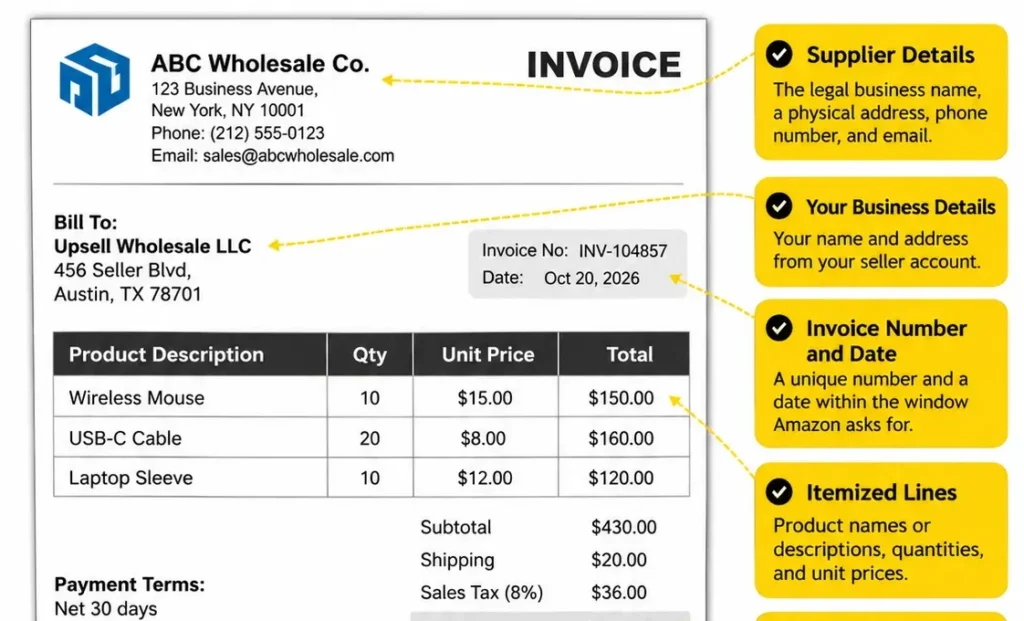
What Should an Invoice Look Like?
Invoices are the paperwork that most often decides whether an approval request goes through. Here is what a clean one contains:
- Supplier details at the top: Legal business name, physical address, phone number, and email matching verified public records.
- Your business details: The exact name and address matching your Amazon Seller Central account.
- Invoice number and date: Unique reference number and a date within Amazon’s required window (typically within 180 days).
- Itemized lines: Exact product names, model/UPC details, quantities, and unit prices for every item (never a single lump sum).
- Totals and payment terms: Complete total amount, freight/shipping lines, and clear payment status or terms.
A Decision Path: Gated or Not, Direct or Distributor?
Use these questions in order before you commit to a supplier for a new product:
1
Is the exact ASIN open to your account?
Check Show limitations in Seller Central. If it is open, move on to question 3. If it is gated, continue to question 2.
2
Does the brand run its own approval process?
If yes, contact the brand first and ask what it requires. If not, find a supplier that can issue itemized invoices and apply with those.
3
Can you meet the brand’s minimums?
If yes, ask about a brand-direct account. If not, look at an authorized distributor that carries the brand.
4
Do the margins hold up under a stress test?
If yes, move on to question 5. If not, the product or supplier is not a fit yet.
5
Can the supplier prove the brand relationship?
If yes, place a small test order. If not, move on to another supplier.
How Does Selling Wholesale on Walmart Marketplace Differ From Amazon?
Many sellers source once and sell on both marketplaces. The sourcing basics are the same, but the approval and fulfillment details differ. If you are exploring selling wholesale on Walmart Marketplace, check the current seller requirements before you buy, because policies change.
| Factor | Amazon | Walmart |
|---|---|---|
| Fulfillment Program | Fulfillment by Amazon (FBA) | Walmart Fulfillment Services (WFS) |
| Approvals | Category and brand approval may apply | Seller approval and some category/brand restrictions apply |
| Supplier Paperwork | Invoices may be requested for approvals | Documentation may also be requested; confirm current rules |
| What to Confirm Before Buying | Restrictions on the exact ASIN | Eligibility of the exact item and your seller account |
Safest Approach: Ask suppliers for itemized invoices and clear brand authorization up front, since both marketplaces can ask for proof of where your products came from.
How Do Wholesale Margins Work? Check the Math Before You Commit
A supplier is only a good fit if the numbers work after every cost. Wholesale margins are what is left after your product cost, marketplace fees, fulfillment, and inbound costs.
| Sample Sale Breakdown | Per Unit (USD) |
|---|---|
| Selling price | $24.99 |
| Wholesale cost | $11.40 |
| Referral fee (15%) | $3.75 |
| FBA fulfillment | $4.50 |
| Inbound shipping and prep | $0.60 |
| Estimated profit | $4.74 |
In this example, estimated profit is about 19% of the selling price, and about 42% ROI on your wholesale cost.
Stress Test: What Happens When Things Move?
| Scenario | Selling Price | Wholesale Cost | Estimated Profit | Margin on Price |
|---|---|---|---|---|
| Base Case | $24.99 | $11.40 | $4.74 | ~19% |
| Price drops to $22.99 | $22.99 | $11.40 | $3.04 | ~13% |
| Price drops to $21.99 | $21.99 | $11.40 | $2.19 | ~10% |
| Supplier raises cost by $1.00 | $24.99 | $12.40 | $3.74 | ~15% |
The Key Takeaway: A modest price drop or cost increase can take a large bite out of your wholesale margins. Always test the downside before you place an order. These figures are illustrative and not a promise of results.
A Worked Example: One Seller, One First Order
The following is a fictional scenario to show how the steps fit together. It is not a promise of results.
Step 1 (Budget & Category): Maya has $3,000 to spend, a registered business, and no selling history. She decides on a single category, pet supplies, because she already understands the products. Searching Seller Central, she finds that most of the brands she likes are open, but one popular brand is gated.
Step 2 (Vetting Leads): She builds a lead list of eight suppliers from a directory and brand websites. Before contacting anyone, she checks each company’s registration and address. Three of the eight cannot show a verifiable address, so she drops them. Of the remaining five, two are authorized distributors that list the brands she wants, and she emails both.
Step 3 (Stress Testing Margins): One distributor replies with a price list and a minimum of $500 for a first order. The other asks for her business documents and offers slightly lower prices at a higher minimum. Maya runs her margin math on three products using a price 10% below the current Buy Box price. Only one product still leaves a healthy margin, so she picks that one.
Step 4 (Test Order & Inspection): She places a small test order of that product rather than spending her full budget. When it arrives, she checks the expiry dates, packaging, and quantities against the invoice. Everything matches, and the invoice is itemized with the supplier’s full business details. She sends the units to Amazon, sells through them, and only then reorders and adds a second product.
The Takeaway: Stick to the order of operations: verify first, run margins under pressure, order small, inspect, and scale only after real-world results hold up.
How Do You Contact a Supplier? An Email Template
Suppliers respond better to buyers who look serious. Have your business documents ready, say where you sell, and name the specific brands you want. Here is a template you can adapt:
OUTREACH TEMPLATE
Subject: Wholesale account inquiry from [Your Business Name]
Hello [Name],
I run [Your Business Name], a registered [LLC/sole proprietorship] in [State], and I sell on Amazon [and Walmart] through [FBA/WFS]. I am looking to open a wholesale account for [Brand 1] and [Brand 2].
Could you please confirm: 1. Whether you are an authorized distributor for these brands, and how I can verify that. 2. Your minimum first order and any volume pricing tiers. 3. What documents you need from me, such as a resale certificate or EIN. 4. Whether you can provide itemized invoices with each order. 5. Your policies on returns, shortages, and damaged goods. 6. Whether you allow your products to be resold on Amazon.
I can send my business documents on request. Thank you for your time.
[Your Name]
[Business Name]
[Phone Number]
What Should You Check on a Test Order?
A test order proves that the supplier delivers what it promised. Start small, and when the shipment arrives, check each of these:
- Quantity: The physical count matches the invoice and purchase order exactly.
- Product condition: No crushed boxes, leaks, seal breaks, or damaged retail packaging.
- Expiry dates & lot codes: Ample shelf life remains for Amazon's strict requirements, and lot codes are consistent.
- Authenticity signals: Packaging, barcodes, and labeling match what the brand sells and what the listing pictures show.
- Invoice details: Business name, address, itemized lines, and dates are complete and consistent.
- Delivery time: The order arrived within the promised window, because lead-time reliability matters as much as price.
- Communication: The supplier answered questions quickly and handled any logistical issue professionally.
Only reorder, or increase order sizes, when the test order passes every point above.
What Are the Red Flags When Evaluating Wholesale Suppliers for Amazon Sellers?
One warning sign does not prove fraud, but unresolved inconsistencies should be settled before you buy.
| Red Flag | Why It Matters | What to Do |
|---|---|---|
| Brand relationship cannot be confirmed | You may be buying from an unauthorized source | Ask for evidence and contact the brand directly |
| Price far below every other source | May signal a different source, grade, or market | Ask where the stock comes from |
| Pressure to buy large amounts early | Removes your chance to verify | Insist on verification and a test order first |
| Vague invoices or mismatched details | May fail Amazon's documentation checks | Request an itemized commercial invoice |
| No written claims, returns, or policy | Leaves you unprotected if goods arrive damaged | Get the policy in writing before paying |
| Payment only with no buyer protection | Raises the cost of a bad deal | Prefer payment methods with some buyer protection |
Is an Amazon Wholesale Course Worth It?
An Amazon wholesale course can shorten the learning curve, but it does not replace verifying suppliers yourself. Courses are most useful for the stages where mistakes are expensive: choosing categories, reading restrictions, calculating margins, and building supplier outreach. Before you pay, check what the course actually covers, whether the material is current, and whether it teaches verification rather than just lead lists.
| Resource | Best For | Cost | Where to Start |
|---|---|---|---|
| Free YouTube Channels | Learning the basics before you spend money | Free | Best Amazon FBA YouTube Channels |
| Paid Wholesale Course | Structured, step-by-step learning | Roughly $500 to $5,000 | 10 Best Amazon Wholesale Courses (2026) |
| Supplier & Service Guidance | Hands-on help with documentation & distribution | $499 | Upsell Wholesale |
Where Does Upsell Wholesale Fit In?
If you would rather not build every supplier relationship from scratch, Upsell Wholesale is a U.S.-based authorized wholesale distributor that helps Amazon, Walmart, and ecommerce sellers source authentic products with documentation and distribution support. It also offers ungating, automation, and account reinstatement services. Explore the options to become a customer and compare them against the checklist in this guide. As with any supplier, outcomes such as Amazon approval, account acceptance, or profitability are never guaranteed, so keep running your own checks.
AUTHORISED U.S. DISTRIBUTOR & SPN PARTNER
What Upsell Wholesale Provides Sellers:
End-to-end sourcing, ungating documentation, and fulfillment prep designed to take the risk out of scaling wholesale.
- Authentic brand-name catalog with verified supply chain invoices.
- FBA & WFS prep, labeling, case-pack packing, and logistics.
- Ungating guidance and documentation review prior to purchasing.
- Account reinstatement assistance and structured seller training.
Final Takeaway: Choosing Wholesale Suppliers for Amazon Sellers
The best wholesale suppliers for Amazon sellers are found through a process, not a lucky search. Know the supplier types, choose the channel that fits your stage, treat wholesale marketplaces as leads rather than proof, check Amazon brand approval requirements before you order, and prove every supplier with a small test order before you scale. If you also sell on Walmart, confirm WFS and brand requirements separately, and always run the margin math before you commit.
A Short Glossary
MOQ (Minimum Order Quantity)
The smallest unit count or order dollar amount a supplier will accept to open an order.
ASIN (Amazon Standard ID Number)
Amazon’s unique 10-character product identifier. Selling restrictions apply to the exact ASIN.
Gated
A brand, category, or sub-category that requires Amazon’s formal approval before you can list it.
LOA (Letter of Authorization)
A formal document from a brand or manufacturer confirming you have permission to resell its products.
Buy Box
The featured offer on an Amazon product page with the “Add to Cart” button. Most sales flow through it.
FBA / WFS
Fulfillment by Amazon and Walmart Fulfillment Services, marketplace fulfillment programs handling storage and shipping.
ROI (Return on Investment)
Net profit divided by your inventory purchase and landed cost (e.g., $4.74 profit ÷ $11.40 cost = ~42% ROI).
Margin on Price
Net profit divided by retail selling price (e.g., $4.74 profit ÷ $24.99 price = ~19% margin).
Brand-Direct
Purchasing inventory directly from the brand or manufacturer without third-party distributor markups.
Resale Certificate
State-issued document proving you purchase goods strictly for resale, exempting you from sales tax at purchase.
Frequently Asked Questions (FAQs)
Brand-direct usually gives the strongest authorization and best pricing, but it comes with higher minimums and stricter approval. Many sellers start with distributors and move top-performing brands to direct accounts as they grow.
Start with one or two for each category so you can build real relationships. Add suppliers as you scale, so a single stockout or policy change does not stop your business.
Show you are a serious buyer: have your business documents ready, explain where you sell, and name the specific brands you want. Ask about volume tiers and a lower first-order option, and expect better terms once you have a purchase history.
No. Wholesale marketplaces help you build a list of leads, but authorization still has to be verified with the supplier and, when needed, the brand.
Both store, pack, and ship your orders, but they serve different marketplaces and have separate eligibility rules, prep requirements, and fees. Compare current rate cards and requirements for your own products.
