

Sell Faster
Introduction
You discover a product that’s selling thousands of units every month. The demand is strong, profit margins look promising, and competition appears manageable. Excited by the opportunity, you log in to Amazon Seller Central, prepare your listing, and click “Sell this product.” Instead of publishing your listing, Amazon displays a message saying:
"Approval Required. You need permission from Amazon before selling this product."
For many sellers, this is their first encounter with Amazon Ungating.
At first glance, the process can seem confusing. Why are some products available for anyone to sell while others require approval? Why do some sellers receive approval within days while others face repeated rejections? More importantly, what does Amazon actually expect before allowing you to sell in restricted categories?
The answer lies in Amazon’s commitment to protecting customers, brands, and the overall integrity of its marketplace. Every day, millions of shoppers trust Amazon to deliver authentic, high-quality products. To maintain that trust, Amazon restricts access to categories and brands that carry a higher risk of counterfeit products, safety concerns, or intellectual property violations. Instead of granting automatic access, the platform requires sellers to demonstrate that they source inventory responsibly and operate as legitimate businesses.
This approval process commonly known as Amazon Ungating isn’t designed to prevent sellers from growing. On the contrary, it’s Amazon’s way of ensuring that businesses entering high-value categories meet the marketplace’s quality standards.
For serious sellers, getting ungated can be a turning point. It opens the door to profitable categories, premium brands, and products with less competition than unrestricted markets. While many new sellers focus only on finding winning products, experienced Amazon businesses understand that expanding into restricted categories is often what separates a growing business from one that struggles to scale.
However, the ungating process has become more detailed in recent years. Amazon now places greater emphasis on supplier verification, product authenticity, wholesale documentation, and account compliance. Simply uploading a document and hoping for approval is no longer enough. Sellers need to understand how the approval process works, what Amazon expects, and how to prepare an application that meets those expectations.
This comprehensive Amazon Ungating Guide has been created to answer those questions. Whether you’re applying for approval for the first time or trying to understand why a previous application was rejected, you’ll find practical insights, expert recommendations, and actionable strategies throughout this guide.
By the end of this article, you’ll understand:
- What Amazon Ungating actually means.
- Why Amazon restricts certain products and brands.
- How to get ungated on Amazon successfully.
- What role Amazon Wholesale Invoices play in the approval process.
- Common mistakes that delay or prevent approval.
- When professional Amazon Ungating Services may help simplify the process.
More importantly, you’ll gain a clear understanding of how to approach ungating as a long-term business strategy rather than a one-time administrative task.
What Is Amazon Ungating?
Before discussing invoices, approval requirements, or documentation, it’s important to understand what Amazon Ungating actually means.
In simple terms, Amazon Ungating is the process of obtaining Amazon’s permission to sell products that fall under restricted categories, restricted brands, or specific products requiring additional approval. Until Amazon grants that permission, you won’t be able to create listings or sell those items through your Seller Central account.
Think of Amazon Ungating as a quality-control system rather than a barrier. Instead of allowing every seller to list every product immediately, Amazon evaluates whether a business meets specific standards before granting access. These standards help Amazon reduce counterfeit products, improve customer trust, and maintain a safer marketplace for buyers and brands alike.
Unlike many eCommerce platforms where almost anyone can begin selling immediately, Amazon carefully monitors who is allowed to sell products that involve higher risks. These risks may relate to product authenticity, consumer safety, brand reputation, or legal compliance.
For example, categories such as dietary supplements, topical skincare, grocery products, fine jewelry, or medical devices often require sellers to provide additional documentation before approval is granted. Likewise, certain well-known brands may have their own approval requirements, even if the category itself is unrestricted.
This is why two sellers can have completely different experiences when attempting to list the same product. One seller may already have approval, while another is asked to submit invoices, product documentation, or authorization letters before proceeding.
Understanding this distinction helps eliminate one of the biggest misconceptions surrounding Amazon Ungating that it is a one-time approval for your entire seller account.
In reality, approvals are usually granted for specific categories, specific brands, or even individual products. Being approved to sell in one restricted category doesn’t automatically give you access to every other restricted product on Amazon.
Why Should Sellers Care About Amazon Ungating?
For some businesses, selling only unrestricted products may be enough. However, for sellers focused on long-term growth, Amazon Ungating offers opportunities that are difficult to ignore.
Many of Amazon’s most profitable categories are restricted for a reason. Since fewer sellers qualify for approval, competition is often lower, allowing businesses to maintain healthier profit margins and build stronger brand portfolios.
Getting ungated can provide several advantages including:
- Access to Premium Products: Sell products from well-known brands and categories that many competitors cannot access.
- Reduced Competition: Restricted categories typically have fewer active sellers, making it easier to compete on quality rather than price alone.
- Higher Profit Potential: Many gated products command stronger margins than products in open categories.
- Greater Business Credibility: Successfully navigating Amazon's approval process demonstrates that your business follows professional sourcing and compliance practices.
- Long-Term Growth Opportunities: Expanding into multiple restricted categories allows sellers to diversify their product catalog and reduce reliance on a single niche.
Rather than viewing ungating as another hurdle, experienced Amazon sellers see it as an investment in the future of their business. Every successful approval creates new opportunities to reach customers, expand inventory, and compete in markets where quality matters more than quantity.
What Does "Gated" Mean on Amazon?
If you’re new to selling on Amazon, you’ve probably come across the term “gated” and wondered what it actually means. In simple terms, a gated category, brand, or product is one that requires Amazon’s approval before you can list and sell it. Until you receive that approval, your listings will remain restricted, regardless of whether you already own the inventory.
Imagine opening a retail store where anyone can sell everyday household items, but products like pharmaceuticals, luxury watches, or premium cosmetics require a business license before they can be placed on the shelves. Amazon follows a similar approach. Instead of allowing unrestricted access to every product, it carefully reviews sellers who want to enter categories that involve higher levels of risk.
When you attempt to list a restricted product, Amazon will usually display a message such as:
"Approval Required. You need approval to list products in this category or from this brand."
For many sellers, seeing this message can be frustrating. However, it shouldn’t be viewed as a roadblock. Instead, think of it as Amazon’s way of maintaining the quality and credibility of its marketplace. The approval process helps ensure that customers receive authentic products while legitimate businesses are protected from unfair competition.
The good news is that being “gated” doesn’t mean you’re permanently restricted. Once you meet Amazon’s requirements and your application is approved, you become “ungated” for that category, brand, or product, allowing you to sell within those restrictions.
Why Does Amazon Restrict Certain Categories and Brands?
One of the biggest misconceptions among sellers is that Amazon creates restrictions simply to make selling more difficult. In reality, the opposite is true. These restrictions exist because Amazon’s success depends on maintaining customer trust.
Every purchase made on Amazon reflects directly on the marketplace. If customers repeatedly receive counterfeit products, expired goods, or unsafe items, they lose confidence not only in individual sellers but also in Amazon itself. To prevent these issues, Amazon has developed strict approval processes for products that require greater oversight.
There are several reasons why Amazon restricts categories and brands, and understanding these reasons helps sellers appreciate why the ungating process is so important.
Protecting Customers from Unsafe Products
Certain products have a direct impact on consumer health and safety. Categories such as dietary supplements, cosmetics, medical devices, and baby products must meet specific quality standards before they reach customers.
By reviewing sellers before granting approval, Amazon reduces the likelihood of counterfeit or non-compliant products entering these sensitive categories.
Preventing Counterfeit Products
Counterfeit products remain one of the biggest challenges in global eCommerce. Popular brands are frequently targeted because of their high demand and strong brand recognition.
Amazon uses the ungating process to verify that sellers obtain their inventory from legitimate wholesale suppliers or authorized distributors. This additional layer of verification protects both customers and brand owners while helping maintain the integrity of the marketplace.
Protecting Brand Reputation
Many manufacturers invest years—sometimes decades—building trust with their customers. To protect that reputation, some brands work closely with Amazon to ensure only qualified sellers can offer their products.
This is particularly common for premium brands where product authenticity, warranty support, and customer experience are essential.
Ensuring Legal and Regulatory Compliance
Certain products are subject to government regulations and industry standards. Electronics, children’s products, food items, medical equipment, and hazardous materials often require compliance certificates or additional documentation before they can be sold legally.
Amazon’s approval process helps verify that sellers understand these requirements and are prepared to meet them.
Improving the Overall Marketplace
Without restrictions, Amazon’s marketplace would quickly become overcrowded with low-quality listings and unreliable sellers. By requiring approval for certain categories, Amazon encourages professional selling practices and creates a better shopping experience for customers.
For legitimate businesses, this often becomes a competitive advantage. Since fewer sellers are approved, those who successfully complete the ungating process frequently benefit from lower competition and stronger pricing opportunities.
Why Amazon Ungating Matters for Serious Sellers
If your goal is simply to sell a few products online, you may never need to think much about Amazon Ungating. However, if you’re building a long-term Amazon business, ungating should be part of your overall growth strategy.
Many of Amazon’s most profitable opportunities exist within restricted categories and premium brands. Sellers who remain limited to open categories often face intense competition, shrinking profit margins, and constant price wars. In contrast, businesses that gain approval to sell gated products often have access to markets with fewer competitors and stronger earning potential.
Rather than viewing ungating as another administrative requirement, successful sellers see it as an investment in future growth.
Some of the biggest advantages include:
Access to Higher-Profit Products
Restricted categories often include products with stronger demand and healthier profit margins. Because fewer sellers qualify for approval, competition tends to be lower than in unrestricted categories.
Reduced Competition
Open categories attract thousands of sellers, making it difficult to compete solely on price. Gated categories create a natural barrier to entry, allowing approved sellers to focus on quality, customer service, and long-term profitability.
Increased Customer Confidence
Customers are more likely to trust products sold within restricted categories because Amazon applies stricter approval standards. Knowing that sellers have passed additional verification can improve buyer confidence and strengthen your reputation.
Better Business Scalability
As your Amazon business grows, relying on only one or two unrestricted categories can become risky. Expanding into multiple approved categories helps diversify your inventory, reduce dependency on seasonal products, and create more stable revenue streams.
In short, Amazon Ungating isn’t just about unlocking new products—it’s about unlocking new business opportunities.
Common Amazon Restricted Categories in 2026
Although Amazon regularly updates its marketplace policies, several categories consistently require approval before sellers can list products. These categories generally involve higher risks related to product authenticity, customer safety, or regulatory compliance.
The table below highlights some of the most commonly restricted categories and the documentation sellers are typically asked to provide.
| Category | Approval Required | Common Documentation |
|---|---|---|
| Grocery & Gourmet Foods | Yes | Wholesale invoices |
| Dietary Supplements | Yes | Wholesale invoices, compliance documents |
| Beauty & Personal Care | Often | Supplier invoices, product information |
| Topical Skin Care | Often | Product authenticity documents |
| Fine Jewelry | Yes | Business verification, invoices |
| Watches | Sometimes | Authorized supplier documentation |
| Medical Devices | Yes | Regulatory compliance certificates |
| Collectible Coins | Yes | Additional verification documents |
| Baby Products | Often | Authentic sourcing documentation |
| Automotive Parts | Sometimes | Product verification and supplier information |
It’s important to remember that Amazon’s requirements can vary depending on your marketplace, account history, and even the specific ASIN you’re applying for. Two sellers may apply for the same category and receive different documentation requests based on Amazon’s internal review process.
For that reason, always refer to the requirements displayed in your Seller Central account rather than relying solely on advice from forums or outdated online guides.
Amazon Restricted Categories vs. Restricted Brands
Many sellers assume that once they’re approved for a restricted category, they automatically gain permission to sell every product within that category. Unfortunately, that’s not always the case.
Amazon distinguishes between restricted categories and restricted brands, and understanding the difference can prevent unnecessary confusion during the application process.
A restricted category applies to an entire group of products. Once Amazon approves your application, you may be eligible to sell products throughout that category, provided no additional brand restrictions apply.
A restricted brand, however, is different. Some manufacturers require separate approval before their products can be sold, even if the surrounding category is unrestricted.
For example, you may already have approval to sell products in the Beauty category, yet still require additional authorization before listing products from a premium skincare brand. Likewise, a seller approved for Grocery products may still need separate permission to sell products from certain nationally recognized food brands.
Brand approvals often involve stricter verification because manufacturers want greater control over how their products are represented on Amazon. Depending on the brand, Amazon may request:
- Wholesale invoices from an authorized distributor
- Letters of authorization
- Product authenticity documentation
- Additional supplier verification
Understanding this distinction helps sellers prepare the correct documentation from the beginning instead of assuming one approval automatically covers every product they wish to sell.
Amazon Ungating Requirements in 2026: Everything You Need Before Applying
Understanding Amazon Ungating is only the first step. The next challenge is preparing an application that meets Amazon’s approval standards. This is where many sellers encounter setbacks not because they’re selling counterfeit products or intentionally violating Amazon’s policies, but because they misunderstand what Amazon is actually evaluating during the review process.
One of the biggest misconceptions is that Amazon approves sellers based solely on a wholesale invoice. While invoices are incredibly important, they represent just one piece of the puzzle. Every ungating application is evaluated as a complete business profile. Amazon reviews your supplier, business documentation, account health, product authenticity, and category-specific requirements before deciding whether to grant approval.
Think of the process as a trust assessment rather than a paperwork exercise. Every document you submit tells Amazon a story about your business where your products come from, how you source inventory, and whether you’re capable of providing customers with a reliable buying experience. The more confidence your application builds, the stronger your chances of getting approved.
In this section of our Amazon Ungating Guide, we’ll explore the essential Amazon Ungating Requirements, explain why Amazon Wholesale Invoices are so important, and discuss how to prepare your business before submitting an application.
Understanding What Amazon Reviews During the Approval Process
Unlike many online marketplaces, Amazon doesn’t simply verify that you’ve uploaded the requested documents and approve your application automatically. Instead, the company reviews multiple aspects of your business to determine whether you’re prepared to sell products within restricted categories.
The goal isn’t to make selling more difficult, it’s to protect customers, maintain brand integrity, and ensure that every product sold through Amazon can be traced back to a legitimate source.
When Amazon reviews an application, it generally focuses on four key areas.
| Review Area | Why Amazon Checks It |
|---|---|
| Product Sourcing | To verify that inventory comes from legitimate wholesale suppliers or manufacturers. |
| Business Documentation | To confirm your invoices and business information are authentic and consistent. |
| Seller Account Health | To evaluate your selling history and compliance with Amazon’s policies. |
| Category-Specific Requirements | To ensure additional documents are provided where required. |
1. Product Sourcing
Every successful ungating application starts with one simple question:
Where did your inventory come from?
Amazon wants sellers to source products through legitimate business channels. Products purchased directly from manufacturers, authorized distributors, or reputable wholesale suppliers are generally viewed much more favorably than inventory purchased from retail stores, liquidation websites, or unknown online marketplaces.
Imagine two sellers applying to sell the same premium skincare product.
The first seller purchased inventory from an authorized distributor and provided detailed wholesale invoices with complete supplier information. The second seller bought identical products from a local retail store and submitted retail receipts as proof of purchase.
Although both sellers may own authentic products, Amazon can only verify one supply chain with confidence. Because the first seller demonstrates a transparent business relationship with a legitimate supplier, their application is far more likely to satisfy Amazon’s review process.
This is why choosing the right supplier is just as important as selecting the right product.
Quick Tip: Before placing a wholesale order, ask your supplier whether they regularly work with Amazon sellers. Suppliers familiar with Amazon’s documentation requirements are more likely to provide invoices that meet Amazon’s approval standards.
2. Business Documentation
Strong documentation is the backbone of every successful Amazon Ungating application.
Amazon isn’t simply looking for paperwork it wants documentation that tells a consistent and verifiable story about your business. Your invoices, authorization letters, compliance certificates, and supporting records should all align with the information registered in your Amazon Seller Central account.
For example, if your Seller Central account is registered under one business name but your invoice lists a different company, Amazon may request clarification or reject the application until the inconsistency is resolved.
Before uploading any document, take a moment to verify:
- Does your registered business name match every invoice?
- Is your business address consistent across all documents?
- Are supplier details complete and easy to verify?
- Are the invoices recent and clearly legible?
- Have you included every page without cropping or editing?
Small inconsistencies often create unnecessary delays. Spending a few extra minutes reviewing your paperwork can significantly improve the quality of your application.
3. Seller Account Health
Many sellers focus entirely on invoices while overlooking another important factor: the health of their Amazon Seller Central account.
Although documentation plays a major role in the approval process, Amazon also considers whether your account reflects responsible selling practices. A seller with strong customer service metrics, accurate listings, and a history of policy compliance naturally inspires more confidence than an account with repeated violations or poor performance.
Some of the key metrics Amazon may consider include:
- Order Defect Rate (ODR)
- Customer feedback and reviews
- Late Shipment Rate
- Valid Tracking Rate
- Policy compliance history
- Overall Account Health Rating
This doesn’t mean new sellers cannot get ungated. Many first-time sellers successfully receive approvals every year. However, maintaining a healthy account demonstrates professionalism and reinforces the trust Amazon is trying to establish through the ungating process.
Think of your account health as your business reputation. Every successful order, positive customer experience, and policy-compliant listing strengthens that reputation over time.
4. Category-Specific Requirements
One mistake many sellers make is assuming every ungating application follows the same checklist.
In reality, Amazon’s requirements vary depending on the category, product type, and brand you’re applying for.
For some categories, wholesale invoices may be all that’s required. Others involve additional documentation to verify product safety, authenticity, or regulatory compliance.
Depending on the category, Amazon may request:
- Product authenticity documents
- Compliance certificates
- Product photographs
- Laboratory testing reports
- Brand authorization letters
- Safety documentation
This is why reading the instructions displayed inside Seller Central is so important. Rather than relying on generic advice found online, always follow the specific requirements Amazon provides for your application.
Basic Requirements Before Applying for Amazon Ungating
Before investing in inventory or preparing documentation, make sure your business is ready for the approval process.
Although Amazon’s exact requirements differ between categories, most successful applications begin with the same foundation.
Before You Apply, Confirm That You Have:
- An active Amazon Seller Central account
- Verified business information
- Accurate tax and identity documents
- A Professional Selling Plan (recommended)
- Healthy account performance
- A legitimate wholesale supplier
These fundamentals may seem straightforward, but overlooking any one of them can create unnecessary delays later in the approval process.
Amazon Wholesale Invoices: The Foundation of Every Successful Ungating Application
Ask experienced Amazon sellers about the most important document in an ungating application, and you’ll almost always hear the same answer:
The wholesale invoice.
Wholesale invoices play a central role because they help Amazon verify the authenticity of your supply chain. They’re not simply proof that you purchased products—they’re evidence that your inventory entered the marketplace through a legitimate business-to-business transaction.
Unfortunately, many first-time sellers misunderstand this requirement. They upload retail receipts, online order confirmations, or invoices from consumer marketplaces, believing these documents will be sufficient. In most cases, they aren’t.
From Amazon’s perspective, buying a product from a retail store doesn’t demonstrate a professional supply chain. A wholesale invoice, however, establishes a direct commercial relationship between your business and an authorized supplier.
That distinction is one of the biggest reasons why some applications succeed while others fail.
What Is a Wholesale Invoice?
A wholesale invoice is an official document issued by a manufacturer, distributor, or wholesale supplier after selling inventory to your business.
Unlike a retail receipt, it contains detailed commercial information that allows Amazon to verify both the supplier and the transaction itself.
A strong wholesale invoice typically includes:
| Invoice Details | Why They Matter |
|---|---|
| Supplier’s legal business name | Confirms the source of inventory |
| Supplier’s address and contact information | Allows Amazon to verify the supplier |
| Your registered business name | Matches your Seller Central account |
| Invoice number | Creates a traceable transaction record |
| Purchase date | Confirms recent inventory sourcing |
| Product descriptions | Shows exactly what was purchased |
| Product quantities | Demonstrates wholesale purchasing |
| Pricing information | Supports a legitimate business transaction |
Every detail contributes to Amazon’s confidence that your inventory comes from a reliable and authentic source.
Common Invoice Mistakes That Lead to Rejection
Even legitimate businesses sometimes receive rejection notices because their documentation doesn’t meet Amazon’s expectations.
Some of the most common mistakes include:
Uploading retail receipts instead of wholesale invoices.
Editing invoice information or removing pages.
Submitting blurry scans or unreadable photographs.
Using invoices with business information that doesn’t match Seller Central.
Purchasing inventory from suppliers that Amazon cannot verify.
Most of these issues are entirely preventable. Taking the time to review your documentation carefully before submitting your application can save days or even weeks of unnecessary delays.
Quick Tip: Before placing a wholesale order, ask your supplier whether they regularly work with Amazon sellers. Suppliers familiar with Amazon’s documentation requirements are more likely to provide invoices that meet Amazon’s approval standards.
How to Get Ungated on Amazon: A Step-by-Step Guide
Now that you understand what Amazon expects before approving a seller, it’s time to put that knowledge into action. While the ungating process may seem intimidating at first, it’s actually quite manageable when approached systematically.
One of the biggest mistakes sellers make is treating Amazon Ungating as a race. They gather a few documents, upload them immediately, and hope for the best. Unfortunately, rushing the process often leads to unnecessary rejections, delayed approvals, and wasted investments in inventory.
Instead, think of your application as a professional business proposal. Every document, invoice, and piece of information should reassure Amazon that you’re a trustworthy seller capable of offering authentic products while maintaining an excellent customer experience.
The following step-by-step process will help you understand exactly how to get ungated on Amazon while avoiding many of the common mistakes that prevent sellers from getting approved.
Step 1: Identify the Product, Brand or Category You Want to Sell
Every Amazon Ungating application starts inside Seller Central.
Search for the product you want to sell or locate the category you’re interested in. If Amazon has placed restrictions on that product or category, you’ll see a notification indicating that approval is required before you can list it.
Typically, the message looks something like this:
“Listing limitations apply. You need approval before listing this product.”
Don’t view this message as a rejection. Instead, consider it an invitation to begin the approval process. Many of Amazon’s highest-performing categories require approval, and thousands of sellers successfully complete this process every year.
Once you’ve identified the restriction, click “Request Approval” to view Amazon’s specific requirements.
Step 2: Carefully Review Amazon’s Requirements
One of the most common reasons applications fail has nothing to do with counterfeit products or poor invoices. Sellers simply skip Amazon’s instructions.
Each category and brand has its own approval criteria. While one application may require only wholesale invoices, another could request additional documentation such as compliance certificates, product images, or letters of authorization.
Before uploading anything, take a few minutes to understand exactly what Amazon is asking for.
Ask yourself the following questions:
- Does Amazon require wholesale invoices only?
- Are product photographs requested?
- Is a compliance certificate required?
- Does this brand require an authorization letter?
- Are there any category-specific instructions?
Reading these requirements carefully before you begin can save valuable time and significantly improve your chances of approval.
Quick Tip: Never assume that because you were approved for one category, every future application will require the same documents. Amazon evaluates each request independently.
Step 3: Gather Your Documentation
Once you know what’s required, the next step is preparing your documents.
This is arguably the most important stage of the Amazon Ungating process because every document you submit contributes to Amazon’s confidence in your business.
Instead of uploading documents immediately, take the time to review them carefully.
Before Submitting Your Application, Confirm That:
- Every invoice is complete and unedited.
- Supplier information is clearly visible.
- Your business name matches your Seller Central account.
- Product descriptions match the items you’re applying to sell.
- Documents are recent and easy to read.
- Every page has been included.
- File quality is clear and professional.
Small mistakes such as uploading blurry scans or accidentally omitting the second page of an invoice can delay the review process even when your inventory is completely legitimate.
Step 4: Submit Your Amazon Ungating Application
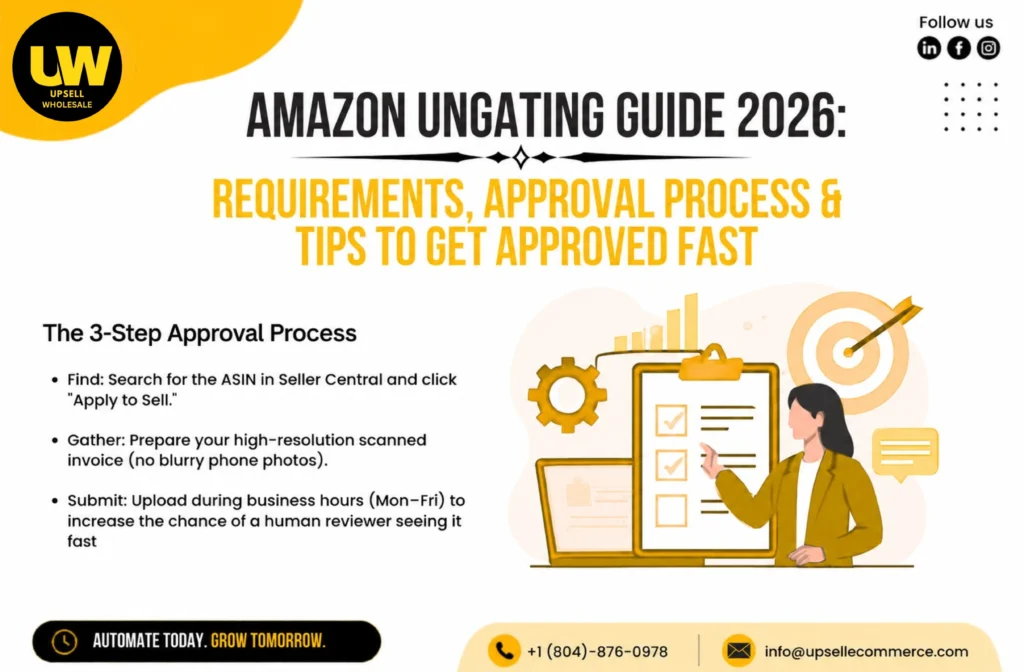
Once your documentation has been reviewed, you can upload the required files through Seller Central.
Although this step is relatively simple, it’s worth remembering that Amazon reviews thousands of applications every day. Making your documents easy to read and professionally organized helps reviewers verify your information more efficiently.
When submitting your application:
- Upload original documents whenever possible.
- Avoid editing, cropping, or modifying invoices.
- Use clear PDF files or high-resolution scans.
- Ensure every uploaded document is complete.
Many sellers unintentionally create problems by editing invoices to remove pricing information or crop unnecessary sections. While these changes may seem harmless, they often make Amazon question the authenticity of the documents.
Whenever possible, submit invoices exactly as they were issued by your supplier.
Step 5: Wait for Amazon’s Review
After submitting your application, Amazon begins reviewing your documentation.
The approval timeline varies depending on several factors, including:
- The category you’re applying for
- The brand involved
- Your seller account history
- Current review volumes
- Whether additional verification is required
Some sellers receive approval within a few business days, while more complex applications may take longer.
During this waiting period, avoid submitting duplicate applications unless Amazon specifically asks you to do so. Multiple submissions can create confusion and sometimes slow down the review process.
Patience is an important part of the process.
Step 6: Respond Quickly if Amazon Requests Additional Information
Receiving a follow-up request from Amazon doesn’t necessarily mean your application has been rejected.
In many cases, Amazon simply requires additional information before making a final decision.
Common requests include:
- Higher-quality invoice copies
- Additional supplier information
- Product photographs
- Compliance certificates
- Authorization letters
- Clarification regarding purchased inventory
Responding promptly and providing complete information helps keep your application moving forward without unnecessary delays.
Ignoring Amazon’s request or providing incomplete documentation may result in your application being closed or rejected.
How Long Does Amazon Ungating Take?
Unfortunately, there isn’t a single answer.
The review timeline depends on several factors, including the complexity of the category, the documentation you’ve submitted, and Amazon’s current workload.
Here’s a general idea of what sellers can expect:
| Application Type | Estimated Timeline* |
|---|---|
| Straightforward category approvals | 1–5 business days |
| Brand-specific approvals | Several days to a few weeks |
| Applications requiring additional documentation | Varies based on response time |
| Complex compliance reviews | May take several weeks |
These timeframes are estimates and can vary depending on Amazon’s review process.
Rather than focusing solely on speed, concentrate on submitting a complete and accurate application the first time. Well-prepared applications generally move through the review process much more smoothly than incomplete ones.
What Happens If Your Application Is Rejected?
A rejection can be frustrating, but it doesn’t always mean you’re permanently denied.
In many cases, Amazon rejects applications because the submitted documentation didn’t provide enough information to verify authenticity or compliance—not because your products were unacceptable.
If your application isn’t approved, take time to review Amazon’s feedback carefully.
Ask yourself:
- Was every requested document included?
- Did my invoices match my Seller Central information?
- Was my supplier easy to verify?
- Did I overlook any category-specific requirements?
Correcting these issues before submitting another application often leads to a much better outcome. Remember, many successful Amazon sellers have experienced at least one rejected ungating application before eventually receiving approval.
Expert Insight
Rather than treating Amazon Ungating as a one-time task, think of it as building a stronger business. The systems you develop today working with reliable suppliers, organizing your documentation, maintaining healthy account metrics, and following Amazon’s policies will continue to benefit your business long after your first approval.
Every successful ungating application creates new opportunities to expand into profitable categories, diversify your product catalog, and strengthen your position within Amazon’s marketplace.
Frequently Asked Questions About Amazon Ungating
Even after understanding the approval process, many sellers still have questions about Amazon Ungating, documentation requirements, and approval timelines. Below are answers to some of the most common questions sellers ask before applying for approval.
Amazon Ungating is the process of receiving Amazon's approval to sell products within restricted categories, restricted brands, or specific ASINs. Until your application is approved, you won't be able to list or sell those products through Amazon Seller Central.
To get ungated on Amazon, you typically need to submit an application through Seller Central along with supporting documents such as wholesale invoices, business information, or category-specific compliance documents.
Although the exact requirements vary by category, successful applications usually demonstrate three things:
- Authentic inventory
- Legitimate wholesale sourcing
- Compliance with Amazon's selling policies
No.
Many product categories are open to all sellers, while others require approval before listings can be created.
Whether you need Amazon Ungating depends entirely on the products and brands you intend to sell.
Amazon Restricted Categories are product categories that require Amazon's approval before sellers can list products.
Some commonly restricted categories include:
- Grocery & Gourmet Foods
- Dietary Supplements
- Fine Jewelry
- Medical Devices
- Beauty Products
- Baby Products
- Collectible Coins
Amazon may update these requirements over time, so always verify category restrictions directly within Seller Central.
Wholesale invoices remain one of the most common requirements for Amazon Ungating, but they aren't required in every situation.
Depending on the category or brand, Amazon may also request:
- Product photographs
- Brand authorization letters
- Compliance certificates
- Testing reports
- Product authenticity documents
Always follow the specific instructions provided for your application.
In most cases, no.
Retail receipts generally don't provide enough information for Amazon to verify a legitimate business-to-business supply chain. Professional wholesale invoices issued by manufacturers or authorized distributors are far more likely to meet Amazon's verification requirements.
Approval times vary depending on the category, brand, and complexity of your application.
Some applications are reviewed within a few business days, while others requiring additional verification may take longer. Submitting complete and accurate documentation from the beginning often helps reduce unnecessary delays.
Amazon may reject an application for several reasons, including:
- Incomplete documentation
- Poor-quality invoice scans
- Business information that doesn't match Seller Central
- Unverified suppliers
- Missing category-specific documents
- Documents that don't meet Amazon's authenticity requirements
Review Amazon's feedback carefully before submitting another application.
Although established seller accounts may have a longer performance history, new sellers can also receive approval provided they meet Amazon's documentation and compliance requirements. Having a newer account doesn't automatically prevent approval.
For many sellers, yes.
Professional Amazon Ungating Services can help review documentation, identify weaknesses in an application, and reduce common mistakes before submission. While no company can guarantee approval, experienced guidance often saves sellers considerable time and frustration.
Final Thoughts
Amazon Ungating may seem complicated when you’re encountering restricted categories for the first time, but the process becomes much more manageable once you understand what Amazon is trying to accomplish.
At its core, Amazon isn’t attempting to make selling more difficult; it is protecting the integrity of its marketplace. Every invoice, supplier document, and compliance record helps Amazon verify that products are authentic, responsibly sourced, and suitable for customers.
Rather than treating ungating as a one-time hurdle, successful sellers approach it as part of a long-term business strategy. Building relationships with reputable wholesale suppliers, maintaining organized documentation, and keeping your Seller Central account in good standing not only improve your chances of approval today but also make future category expansions much easier.
Whether you’re applying for your first restricted category or expanding into premium brands, preparation is the key to success. A carefully planned application backed by legitimate documentation will always perform better than one submitted in haste.
As Amazon continues to strengthen its marketplace policies, sellers who invest in compliance, transparency, and professional sourcing practices will be better positioned to grow sustainable businesses and unlock new opportunities.
How Upsell Wholesale Helps Amazon Sellers Get Ungated?
Preparing documentation, sourcing from the right suppliers, and understanding Amazon’s approval requirements can be challenging especially if you’ve already experienced one or more rejected applications.
At Upsell Wholesale, we help Amazon sellers navigate the ungating process with confidence. Our team works closely with businesses to review documentation, identify potential issues before submission, and provide guidance tailored to Amazon’s current approval requirements.
Whether you’re trying to sell in restricted categories, gain approval for premium brands, or better understand Amazon Wholesale Invoice requirements, our experienced team is here to support your growth.
Ready to expand into profitable Amazon categories? Contact Upsell Wholesale today and take the next step toward growing your Amazon business with confidence.
