
 /
/ 



Amazon Seller Account Reinstatement in 2026: The Ultimate Guide to Recover Your Suspended Account and Build a Stronger Amazon Business
Imagine spending months or even years building your Amazon business.
You invest thousands of dollars into inventory, establish relationships with suppliers, optimize product listings, manage customer service, and work tirelessly to increase sales. Slowly but surely, your efforts begin paying off. Orders become consistent, revenue grows and your business starts gaining momentum.
Then one day, everything changes.
You log into Seller Central and see a notification that instantly causes panic:
“Your Amazon selling privileges have been removed.
- What happened?
- Why was my account suspended?
- Can I get my account back?
- What happens to my inventory?
- Will Amazon hold my funds?
- How long will the reinstatement process take?
For many sellers, an Amazon suspension is more than just an account issue. It directly affects cash flow, inventory management, supplier relationships, customer trust and future growth plans.
The emotional and financial impact can be significant, especially for businesses that rely heavily on Amazon as their primary sales channel.
The good news is that a suspension does not automatically mean the end of your Amazon business.
Every year, thousands of sellers successfully complete Amazon seller account reinstatement and regain their selling privileges. In many cases, businesses emerge stronger because the reinstatement process forces them to improve systems that were already creating hidden risks.
One of the biggest mistakes sellers make after receiving a suspension notice is immediately sending multiple appeals without fully understanding the root cause of the issue.
Others search online for generic appeal templates and simply copy and paste them into Amazon’s appeal system.
Unfortunately, that approach rarely works.
Amazon’s compliance teams and automated review systems have become increasingly sophisticated. Generic responses, emotional explanations and vague promises often fail because they do not address the underlying business problem.
Amazon doesn’t want excuses.
Amazon wants solutions.
- Account Health issues
- Inauthentic product complaints
- Intellectual Property violations
- Amazon Section 3 suspensions
- Related account suspensions
- Policy violations
- Product authenticity concerns
What Is Amazon Seller Account Reinstatement?
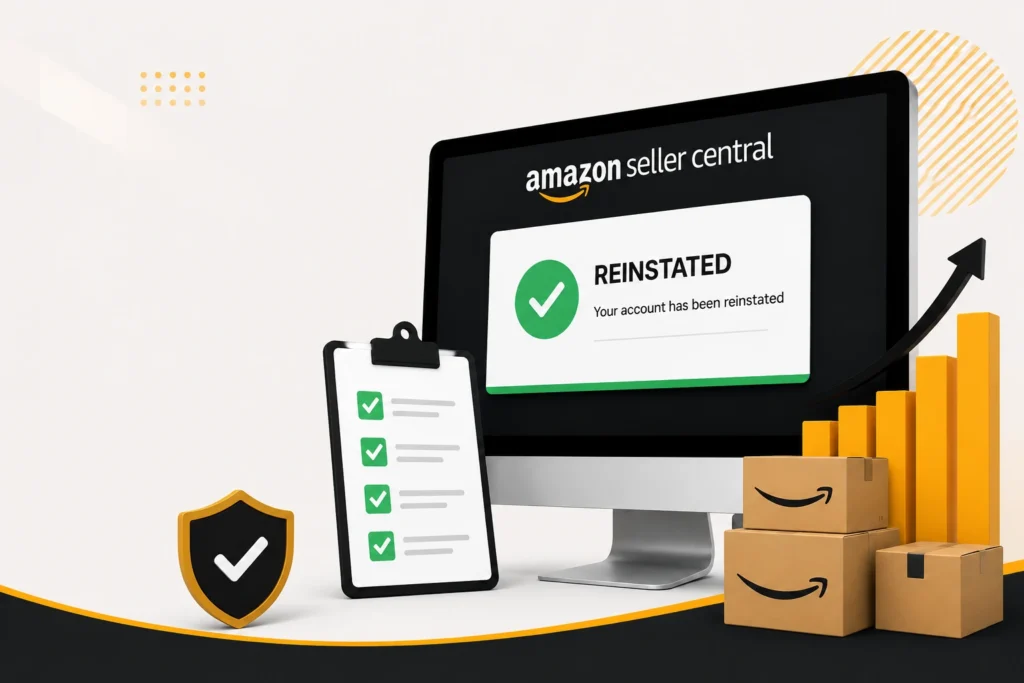
Amazon seller account reinstatement is the process of restoring a seller’s ability to sell on amazon after their account has been suspended, deactivated or restricted due to policy violations, account health concerns, product authenticity issues, intellectual property complaints, or other compliance-related problems.
To regain access to the marketplace, sellers must identify the root cause of the issue, correct the problem and demonstrate to Amazon that effective preventive measures have been implemented.
In most situations, Amazon requires sellers to submit a detailed appeal, commonly known as a Plan of Action (POA).
A successful appeal typically explains:
- Root Cause: What caused the problem?
- Corrective Actions: What actions have already been taken to resolve the issue?
- Preventive Measures: What systems have been implemented to prevent future violations?
In 2026, Amazon seller account recovery is no longer about submitting a simple apology.
Amazon expects sellers to provide evidence, documentation, operational improvements and long-term solutions that reduce risk for customers and the marketplace.
Why Amazon Is Becoming Stricter Every Year
Many sellers assume Amazon wants to suspend accounts as quickly as possible.
In reality, Amazon’s business model depends entirely on customer trust.
Customers shop on Amazon because they expect:
- Authentic products
- Fast delivery
- Accurate listings
- Reliable customer service
- Safe transactions
If customer trust declines, Amazon’s marketplace becomes less valuable for everyone.
This is why Amazon continuously monitors seller performance.
Every seller generates data points that Amazon evaluates, including:
- Customer complaints
- Product returns
- Order defect rates
- Late shipment rates
- Intellectual property complaints
- Policy violations
- Product authenticity concerns
- Customer feedback
- Performance notifications
Amazon’s systems analyze these signals continuously.
Many suspensions do not happen overnight.
Instead, they often result from a series of smaller issues that accumulate over time.
For example:
A seller may ignore a few customer complaints because sales remain strong.
Another seller may purchase inventory from suppliers without properly verifying product authenticity.
Someone else may overlook Account Health warnings because their revenue continues growing.
Weeks or months later, those seemingly minor issues can evolve into serious compliance concerns.
This is why successful Amazon sellers view compliance as an ongoing business process rather than a one-time task.
The sellers who survive long term understand that preventing suspensions is significantly easier than recovering from them.
The Most Common Reasons Amazon Suspends Seller Accounts
Every suspension is different, but certain patterns appear repeatedly across thousands of Amazon seller suspension cases.
The table below outlines some of the most common reasons sellers lose their selling privileges.
| Suspension Reason | Difficulty Level | Recovery Potential |
|---|---|---|
| Poor Account Health | Medium | High |
| Inauthentic Product Complaints | High | High |
| Intellectual Property Violations | High | Moderate |
| Related Account Violations | Very High | Moderate |
| Review Manipulation | Very High | Difficult |
| Policy Violations | High | High |
| Section 3 Violations | Very High | Difficult |
Understanding the exact reason behind your suspension is critical because every situation requires a different recovery strategy.
One of the biggest mistakes sellers make is assuming every suspension can be solved with the same appeal template.
That simply isn’t true.
An inauthentic complaint requires a completely different approach than a Section 3 suspension.
An intellectual property complaint requires different documentation than an Account Health issue.
Amazon expects sellers to investigate their own business operations and identify the actual root cause before requesting reinstatement.
The more accurately you identify the problem, the stronger your appeal becomes.
The First 48 Hours After Suspension Matter the Most
The biggest enemy after receiving a suspension notice is panic.
Panic causes sellers to make poor decisions.
Many businesses immediately submit multiple appeals without understanding what Amazon is actually asking for.
Others become emotional and focus on explaining how much revenue they’ve lost rather than addressing the compliance issue.
Neither approach is effective.
Instead, the first step should be slowing down and carefully reviewing Amazon’s suspension notification.
Read the email multiple times.
Pay attention to:
- Policy references
- Requested documentation
- Specific wording
- Dates mentioned
- Performance concerns
- Product references
- Customer complaints
Amazon often provides clues within the notification itself.
Many sellers focus only on the headline while overlooking important details buried in the message.
In some cases, the issue Amazon identifies is only a symptom of a deeper operational problem.
For example, an inauthentic complaint may actually reveal weaknesses in supplier verification procedures.
A policy violation may expose problems with employee training or listing management.
The suspension itself is often the result of larger business issues that need to be addressed.
Understanding this perspective dramatically improves the quality of your recovery strategy.
Understanding Amazon's Plan of Action (POA) Requirements
Amazon uses the POA to determine whether a seller understands the problem and has implemented meaningful improvements.
A strong POA generally contains three critical components.
Root Cause Analysis
Clearly explain what caused the issue.
Avoid blaming:
- Amazon
- Competitors
- Customers
- External circumstances
Amazon wants accountability.
The strongest appeals acknowledge mistakes and demonstrate a clear understanding of the underlying problem.
Corrective Actions
Describe the specific steps already taken to resolve the issue.
Examples may include:
- Removing affected inventory
- Updating product listings
- Verifying supplier documentation
- Improving quality-control procedures
- Retraining staff members
- Reviewing customer complaints
Corrective actions should focus on completed improvements rather than future intentions.
Preventive Measures
Explain how future violations will be prevented.
Examples include:
- Monthly compliance audits
- Supplier verification programs
- Employee training systems
- Inventory tracking procedures
- Account Health monitoring routines
- Internal compliance checklists
Amazon wants confidence that the issue will not happen again.
The strongest Amazon appeal letters focus on evidence, operational improvements and long-term business processes.
Understanding How Amazon Evaluates Your Business
Many sellers imagine Amazon reviews appeals randomly.
In reality, Amazon follows a structured trust-based evaluation process.
Before making a reinstatement decision, Amazon typically evaluates several areas.
| Review Stage | Amazon’s Focus |
|---|---|
| Policy Investigation | What rule was violated |
| Risk Assessment | Impact on customers |
| Documentation Review | Quality and authenticity of evidence |
| Appeal Evaluation | Seller’s explanation and corrective actions |
| Trust Assessment | Long-term prevention systems |
| Final Decision | Reinstatement eligibility |
Why Emotional Appeals Almost Always Fail
When sellers receive a suspension notice, it’s completely normal to feel frustrated, confused or even angry.
Unfortunately, many sellers allow those emotions to influence their appeal.
Amazon receives countless appeals that focus on:
- Lost revenue
- Business hardships
- Financial stress
- Employee payroll concerns
- Personal circumstances
While these challenges may be real, they do not help Amazon determine whether your business is safe to operate on the marketplace.
Amazon’s priority is customer protection.
The company wants evidence that the problem has been identified, corrected and prevented from happening again.
Consider these two approaches:
⚠️ Weak Appeal
We have lost a lot of money because of this suspension. We are a small business and need our account back as soon as possible.
⚠️ Strong Appeal
After investigating the issue, we identified weaknesses in our supplier verification process. We have implemented a new supplier approval system, organized all invoices and established monthly compliance audits to prevent future authenticity concerns.
The second response focuses on solutions rather than emotions.
That is exactly what Amazon wants to see.
A Real Case Study: How a Wholesale Seller Recovered a Six-Figure Amazon Business
One wholesale business generating more than $150,000 per month suddenly received several inauthentic product complaints.
Initially, the owners believed competitors were targeting their listings.
They assumed the complaints were unfair.
However, after conducting a thorough internal review, they discovered multiple operational weaknesses.
Products were being sourced from several distributors.
Invoices were stored inconsistently.
Some team members were adding products without following proper supplier verification procedures.
Instead of blaming Amazon, the business focused on fixing the problem.
The company:
- Centralized invoice management
- Verified all suppliers
- Removed questionable inventory
- Retrained staff members
- Created compliance documentation procedures
- Implemented monthly account audits
After completing these improvements, they submitted a detailed appeal explaining:
- What happened
- Why it happened
- What had already been fixed
- How future risks would be prevented
The account was reinstated.
More importantly, the business became stronger because the suspension forced leadership to fix problems that had existed for years.
This illustrates an important lesson.
Many Amazon suspensions expose weaknesses that sellers never noticed before.
Sometimes the reinstatement process becomes the catalyst for building a more sustainable business.
Building a Strong Amazon Business After Reinstatement
One of the biggest misconceptions about Amazon seller account reinstatement is that reinstatement represents the finish line.
It doesn’t. In reality, reinstatement is often a second chance.
Many sellers invest enormous effort recovering their accounts, only to face another suspension months later because they never addressed the underlying operational issues.
Imagine repairing a leaking roof while ignoring a damaged foundation.
The problem may temporarily disappear, but eventually it returns.
The same principle applies to Amazon businesses.
The sellers who thrive long term are not necessarily the largest sellers.
They are the sellers who build strong systems behind the scenes.
Once your account is reinstated, your focus should immediately shift from recovery to prevention.
Think of your Amazon business as a system made up of multiple moving parts:
- Supplier management
- Inventory control
- Customer service
- Compliance monitoring
- Employee training
- Listing management
- Account health oversight
When one area becomes weak, the entire business becomes vulnerable.
Successful sellers understand that long-term growth requires operational stability.
Revenue creates growth.
Compliance protects growth.
Both are equally important.
The Seller Recovery Framework Every Amazon Business Should Follow
Many successful Amazon businesses use a simple framework to reduce risk and maintain compliance.
You don’t need expensive software or a large team to implement it.
You simply need consistency.
The framework consists of four key areas.
Stage One: Protect Your Suppliers
Many Amazon suspensions begin with supplier-related problems.
A seller purchases inventory from an unauthorized source.
Documentation is incomplete.
Invoices are unavailable.
Products cannot be properly verified.
Months later, an authenticity complaint appears and Amazon requests documentation.
Suddenly, the seller realizes they cannot provide adequate evidence.
To avoid this situation:
- Work with legitimate suppliers
- Maintain organized invoices
- Verify supplier credentials
- Store documentation digitally
- Review sourcing procedures regularly
Every product entering your inventory should have a clear paper trail.
If Amazon requests documentation tomorrow, you should be able to provide it immediately.
Stage Two: Protect Your Customers
Amazon closely monitors customer satisfaction.
Customers often identify problems before Amazon does.
Repeated complaints about:
- Product quality
- Packaging
- Shipping
- Authenticity
- Product descriptions
Can eventually trigger compliance concerns.
Rather than viewing complaints negatively, treat them as valuable feedback.
Customer complaints frequently reveal operational weaknesses that require attention.
Businesses that actively resolve customer issues often maintain stronger account health over time.
Stage Three: Protect Your Team
As businesses grow, responsibilities become divided.
One employee manages listings.
Another handles inventory.
Someone else manages customer support.
Without clear procedures, mistakes become inevitable.
This is why employee training matters.
Every person accessing Seller Central should understand:
- Amazon policies
- Listing requirements
- Compliance expectations
- Documentation procedures
- Account health metrics
Many suspensions occur because a single employee unknowingly violates a policy.
Training is one of the most cost-effective investments an Amazon business can make.
Stage Four: Protect Your Account Daily
Many sellers only review Account Health after something goes wrong.
That approach is risky.
Account Health should become part of your daily routine.
Just as you review:
- Orders
- Sales
- Inventory
You should also review compliance metrics.
Even five minutes per day can help identify risks before they become serious problems.
Small issues are easier to fix than major suspensions.
Understanding Amazon Performance Notifications
Amazon often provides warning signs before taking serious action.
One of the most important warning systems is Performance Notifications.
These notifications appear within Seller Central and may involve:
- Policy violations
- Intellectual property complaints
- Product authenticity concerns
- Customer complaints
- Account health warnings
- Listing issues
Unfortunately, many sellers ignore these notifications because their business appears to be operating normally.
That can be a costly mistake.
Performance Notifications should be treated with urgency.
Ignoring warnings allows small problems to grow into larger compliance concerns.
Successful sellers review Seller Central regularly and investigate every notification promptly.
In many cases, addressing a warning early can prevent a future suspension entirely.
Small Problems That Quietly Become Major Suspensions
One reason suspensions often feel unexpected is because sellers underestimate the significance of small issues.
Consider these examples:
- A few negative reviews
- A handful of late shipments
- One authenticity complaint
- A listing error
- An ignored warning notification
Individually, these issues may appear minor. Collectively, they create risk.
Amazon’s systems evaluate patterns over time.
A business that consistently accumulates small problems becomes increasingly vulnerable.
This is why routine audits are so valuable.
Every month, ask yourself:
- Are invoices organized?
- Are customer complaints increasing?
- Are listings accurate?
- Are suppliers verified?
- Are employees following procedures?
- Are policy updates being reviewed?
Simple questions often uncover problems before Amazon does.
Why More Businesses Are Using Amazon Reinstatement Services
Amazon’s compliance environment continues becoming more complex.
As a result, many businesses seek professional assistance during the reinstatement process.
This is where Amazon reinstatement services can provide value.
Experienced professionals can help:
- Identify root causes
- Review documentation
- Analyze suspension notices
- Develop stronger appeals
- Improve compliance systems
However, sellers should understand an important reality:
No legitimate company can guarantee reinstatement.
If an agency promises guaranteed approval, that should be considered a warning sign.
A reputable Amazon Account Reinstatement Service focuses on improving the quality of your case rather than making unrealistic promises.
Professional guidance can be especially helpful for:
- Section 3 suspensions
- Related account violations
- Multiple appeal rejections
- Intellectual property disputes
- Complex compliance issues
The goal is not simply writing a better appeal.
The goal is creating a stronger business.
Need Help With an Amazon Suspension?
Every Amazon suspension is different.
What works for one seller may not work for another.
Whether you’re facing:
- Inauthentic product complaints
- Account Health issues
- Section 3 violations
- Intellectual Property complaints
- Multiple appeal rejections
The most important step is identifying the true root cause of the problem.
At Upsell Wholesale, we help Amazon sellers understand Amazon’s expectations, strengthen internal compliance systems and develop recovery strategies designed to support long-term business growth.
Successful reinstatement isn’t just about recovering an account.
It’s about building a business that is less likely to face future compliance issues.
The Hidden Cost of Amazon Account Suspensions
Most sellers focus on lost revenue.
But suspensions affect far more than sales.
Potential consequences include:
- Delayed inventory planning
- Supplier relationship disruptions
- Advertising interruptions
- Reduced customer trust
- Employee productivity issues
- Cash flow challenges
- Delayed expansion plans
The longer a suspension continues, the more significant these effects become.
This is why prevention deserves so much attention.
Investing a few hours each week into compliance monitoring can save months of recovery work later.
Successful businesses don’t wait for problems to appear.
They actively search for them.
A Weekly Compliance Checklist Every Amazon Seller Should Follow
Rather than overwhelming yourself with complicated systems, start with a simple weekly routine.
| Weekly Task | Purpose |
|---|---|
| Review Account Health | Detect risks early |
| Organize Supplier Invoices | Prepare for verification requests |
| Audit Product Listings | Prevent listing violations |
| Review Customer Feedback | Improve customer satisfaction |
| Check Policy Updates | Maintain compliance |
| Train Employees | Reduce human error |
This process may only require a few hours per week.
However, consistent monitoring can significantly reduce future suspension risks.
In Amazon’s marketplace, consistency almost always beats complexity.
What Happens to Your Inventory, Funds, and Listings During an Amazon Suspension?
One of the first questions sellers ask after receiving a suspension notice is:
What happens to my business now?
The answer depends on the specific type of suspension and Amazon’s assessment of the situation.
In many cases:
- Product listings become inactive
- Customers can no longer place orders
- Advertising campaigns stop running
- Account funds may be temporarily reserved
- Inventory remains in Amazon fulfillment centers
This uncertainty can be stressful, especially for businesses with significant inventory investments or ongoing supplier commitments.
Many sellers mistakenly assume their inventory is immediately lost.
Fortunately, that is usually not the case.
Amazon often allows sellers to recover inventory or request inventory removals depending on the circumstances.
However, the process varies based on the reason for the suspension and Amazon’s internal review procedures.
This is one reason why relying entirely on a single sales channel can be risky.
Successful ecommerce businesses increasingly diversify across multiple channels to reduce dependency on any one platform.
| Weekly Task | Purpose |
|---|---|
| Review Account Health | Detect risks early |
| Organize Supplier Invoices | Prepare for verification requests |
| Audit Product Listings | Prevent listing violations |
| Review Customer Feedback | Improve customer satisfaction |
| Check Policy Updates | Maintain compliance |
| Train Employees | Reduce human error |
This process may only require a few hours per week.
However, consistent monitoring can significantly reduce future suspension risks.
In Amazon’s marketplace, consistency almost always beats complexity.
The Difference Between Temporary Deactivation and Permanent Suspension
Many sellers use these terms interchangeably, even though they represent very different situations.
| Account Status | Meaning | Difficulty |
|---|---|---|
| Listing Suppression | Specific listings removed | Moderate |
| Temporary Deactivation | Additional information required | Moderate |
| Account Suspension | Selling privileges removed | High |
| Permanent Ban | Severe policy violations | Very High |
Temporary deactivation often means Amazon believes the issue can potentially be corrected.
Permanent suspensions generally indicate Amazon considers the account to represent a significantly higher risk.
Understanding the type of enforcement action you’re facing is critical because it affects your appeal strategy.
Many sellers waste valuable time using the wrong approach simply because they misunderstand their account status.
The Biggest Myths About Amazon Seller Account Reinstatement
There is a tremendous amount of misinformation online regarding Amazon suspensions.
Unfortunately, following bad advice can make recovery even more difficult.
Let’s address some of the most common myths.
Myth #1: Sending More Appeals Improves Your Chances
Many sellers believe submitting multiple appeals every day will speed up the review process.
This is rarely true.
In some situations, repeatedly sending weak appeals can actually slow down the process and create additional confusion.
Quality is more important than quantity.
A single well-prepared appeal is usually far more effective than ten rushed submissions.
Myth #2: Appeal Templates Always Work
The internet is full of generic Amazon appeal templates.
While templates may provide a basic structure, they rarely address the unique circumstances of a specific suspension.
Amazon reviews thousands of appeals every day.
Generic language is easy to recognize.
Successful appeals are customized to reflect the seller’s actual business operations, corrective actions, and preventive measures.
Myth #3: Competitors Cause Most Suspensions
Some sellers immediately blame competitors whenever a suspension occurs.
While false reports occasionally happen, most suspensions originate from operational weaknesses that already existed within the business.
Successful sellers focus on identifying and fixing those weaknesses rather than searching for someone to blame.
Myth #4: Only New Sellers Get Suspended
Many people assume account suspensions only affect inexperienced sellers.
That assumption is incorrect.
Large brands, established wholesalers, and experienced ecommerce businesses receive suspensions as well.
Amazon’s compliance standards apply to everyone.
No seller is immune.
Myth #5: Reinstatement Means the Problem Is Solved Forever
Reinstatement is not the finish line.
Businesses that fail to improve their internal systems often face future compliance issues.
Long-term success requires continuous improvement.
How Artificial Intelligence Is Changing Amazon Compliance in 2026
Amazon continues investing heavily in automation and artificial intelligence.
This means account reviews are no longer conducted solely by human teams.
Advanced systems continuously monitor marketplace activity.
Examples include:
- Sudden spikes in negative reviews
- Unusual login behavior
- Suspicious account activity
- Rapid listing modifications
- Product authenticity concerns
- Customer complaint trends
- Performance metric fluctuations
These systems help Amazon identify potential risks more quickly than ever before.
This does not mean sellers should become fearful.
It means businesses should become more organized.
The more structured your processes are the easier it becomes to adapt to evolving compliance standards.
Sellers who build strong documentation systems today will be better positioned for future marketplace changes.
The Importance of Building a Business Beyond Amazon
One of the most valuable lessons many suspended sellers learn is that relying entirely on Amazon creates significant risk.
Amazon is an incredible platform.
However, it should not be the only foundation supporting your business.
Many successful sellers eventually expand into additional channels such as:
- Shopify websites
- Email marketing
- Social media communities
- Walmart Marketplace
- eBay
- Wholesale distribution
- Direct-to-consumer sales
Diversification creates stability.
When revenue comes from multiple sources, temporary disruptions become easier to manage.
Building a brand beyond Amazon doesn’t just reduce risk.
It creates additional opportunities for growth and customer retention.
The strongest ecommerce businesses treat Amazon as an important sales channel—not their entire business.
How Businesses Can Prepare Before a Suspension Ever Happens
One of the smartest things a seller can do is prepare for potential compliance requests before problems occur.
Think of it as business insurance.
Create a secure digital folder containing:
- Supplier invoices
- Business registration documents
- Tax documentation
- Product sourcing records
- Employee compliance procedures
- Customer service guidelines
- Quality-control processes
Many sellers spend days searching for documents after Amazon requests them.
Preparation eliminates unnecessary delays and stress.
When documentation is organized, responding to Amazon becomes significantly easier.
Choosing the Right Amazon Account Reinstatement Service
There are hundreds of companies offering Amazon reinstatement services.
Unfortunately, not all of them provide quality support.
Choosing the wrong service provider can cost valuable time and money.
Before hiring any reinstatement company, ask important questions:
How Much Experience Do They Have?
Choose a provider with a proven track record of successfully handling Amazon account suspensions, policy violations, and compliance issues.
Do They Customize Every Appeal?
Avoid services that rely on generic templates. Every suspension is different and requires a tailored Plan of Action.
Do They Clearly Explain Their Process?
Transparency is a strong indicator of professionalism. A reputable provider should explain each step before submitting your appeal.
Do They Help Prevent Future Suspensions?
The right service should strengthen your Amazon business by improving compliance—not just submit paperwork.
Do They Promise Guaranteed Reinstatement?
If so, proceed with caution. No legitimate company can guarantee Amazon’s final decision.
The best Amazon Account Reinstatement Service providers focus on identifying root causes, improving compliance processes, and creating long-term solutions that help protect your seller account.
Amazon Marketplace Growth and Why Compliance Matters More Than Ever
Amazon remains one of the largest ecommerce marketplaces in the world.
As the marketplace grows, Amazon continues investing heavily in:
- Customer protection
- Product authenticity verification
- Fraud prevention
- Compliance monitoring
- Marketplace integrity
This means seller compliance is becoming increasingly important.
Businesses that prioritize:
- Accurate documentation
- Supplier verification
- Customer satisfaction
- Account Health management
- Employee training
are better positioned for long-term success.
The future belongs to sellers who view compliance as a competitive advantage rather than a burden.
Final Thoughts: A Suspension Doesn't Have to End Your Business
Every successful Amazon seller eventually learns an important lesson:
Growth is not just about increasing sales.
Growth is about building stronger systems.
An account suspension can feel overwhelming.
It can disrupt revenue, create uncertainty, and force difficult business decisions.
However, it can also become an opportunity.
Many businesses that successfully recover from suspensions emerge stronger than they were before.
They:
- Improve supplier management
- Strengthen documentation processes
- Enhance customer service
- Monitor compliance more closely
- Create better internal procedures
- Build more resilient operations
In many cases, reinstatement becomes a turning point rather than an ending.
If your account is currently suspended, focus on solutions rather than panic.
Investigate the root cause.
Take responsibility.
Implement meaningful improvements.
Document every action.
Most importantly, build a business that Amazon can trust for years to come.
Your goal should never be simply recovering your account.
Your goal should be building a business that never needs another reinstatement.
Frequently Asked Questions (FAQs)
Every case is different. Some sellers receive responses within a few days, while more complex suspensions may take several weeks or longer.
No. Attempting to bypass a suspension by creating a new account may result in additional enforcement actions and permanent restrictions.
It depends on the complexity of your situation. Straightforward cases may be handled internally, while more complicated suspensions often benefit from professional guidance.
Amazon may request invoices, supplier information, business registration documents, utility bills, identity verification documents, or additional supporting evidence depending on the situation.
Section 3 suspensions, related account violations, review manipulation cases, and repeated intellectual property complaints are generally among the most difficult.
Not every account can be recovered. However, many businesses successfully regain access by identifying the root cause and implementing meaningful corrective actions.
If your appeals have been rejected multiple times or your case is particularly complex, professional assistance may help improve your recovery strategy.
The first step is understanding the exact reason behind the suspension. Once the root cause is identified, businesses can either manage the appeal internally or seek professional support.
If your appeals have been rejected multiple times or your case is particularly complex, professional assistance may help improve your recovery strategy.
A Plan of Action is a formal appeal document submitted to Amazon that explains the root cause of the issue, corrective actions taken and preventive measures implemented to avoid future violations.
Yes. Severe policy violations, repeated compliance failures, review manipulation or attempts to circumvent previous suspensions can lead to permanent account restrictions.
Amazon does not publicly specify a maximum number of appeals. However, repeatedly submitting weak appeals may reduce the likelihood of success.
Depending on the type of suspension, inventory may remain in Amazon fulfillment centers while the account is under review. Sellers should carefully review Amazon's instructions regarding inventory removal and recovery options.
The timeframe varies based on the suspension type and Amazon's internal review process. Funds may remain temporarily reserved while Amazon evaluates potential customer claims and account risks.
About the Author
Written by the Upsell Wholesale Amazon Compliance Team
The Upsell Wholesale Amazon Compliance Team specializes in helping Amazon sellers navigate account suspensions, policy violations, account health concerns, supplier verification challenges and marketplace compliance requirements.
With extensive experience supporting ecommerce businesses, our team works closely with sellers to identify root causes, strengthen operational processes, improve account health and develop long-term compliance strategies designed to support sustainable growth on Amazon.
Our goal is not only to help sellers recover from account suspensions but also to build stronger, more resilient businesses that can thrive in an increasingly competitive marketplace.
Whether you’re facing an Amazon account suspension, Section 3 violation, inauthentic product complaint, intellectual property issue or account health challenge, our team is committed to providing practical guidance and solutions based on Amazon’s evolving compliance standards.
Why Trust Upsell Wholesale?
- Amazon Seller Account Reinstatement Support
- Amazon Suspension Appeal Guidance
- Account Health & Compliance Strategy
- Wholesale Supplier Verification Assistance
- Amazon FBA Growth & Operations Consulting
- Long-Term Marketplace Risk Prevention
At Upsell Wholesale, we believe successful Amazon businesses are built on compliance, transparency, strong supplier relationships and exceptional customer experiences. Our mission is to help sellers create sustainable systems that support long-term marketplace success.
Need Expert Support?
If your Amazon business is dealing with account suspensions, multiple appeal rejections, inauthentic product complaints, Section 3 violations, intellectual property issues, or complex compliance challenges, professional guidance can help you navigate the recovery process more effectively.
At Upsell Wholesale, we help sellers identify root causes, strengthen compliance systems, organize documentation, and develop long-term strategies designed to support sustainable marketplace growth.
A successful reinstatement is not just about restoring selling privileges.
It’s about creating a stronger, more resilient business prepared for long-term success.
Need help with Amazon seller account reinstatement? Contact the Upsell Wholesale team to discuss your situation and explore the best path forward.
Need Help With Your Amazon Section 3 Suspension?
Upsell Wholesale’s team has analyzed hundreds of Section 3 suspension notices. Contact us to analyze your suspension notice, audit documentation, and prepare an evidence-backed Plan of Action.
