


Understanding Amazon Section 3 Suspensions and How to Avoid Them
Few things are more alarming for Amazon sellers than receiving a suspension notice referencing Section 3 of Amazon’s Business Solutions Agreement. A Section 3 suspension can stop your business overnight, freeze your ability to sell, delay payouts, and put your inventory at risk.
Many sellers believe these suspensions happen without warning. In reality, Amazon usually identifies trust, compliance, or policy concerns long before enforcement occurs.
The Most Important Thing to Understand:
Amazon Section 3 is not the problem. It is the result of a problem Amazon believes already exists. Before submitting an appeal, you must identify the real reason Amazon took action.
What Is Amazon Section 3?
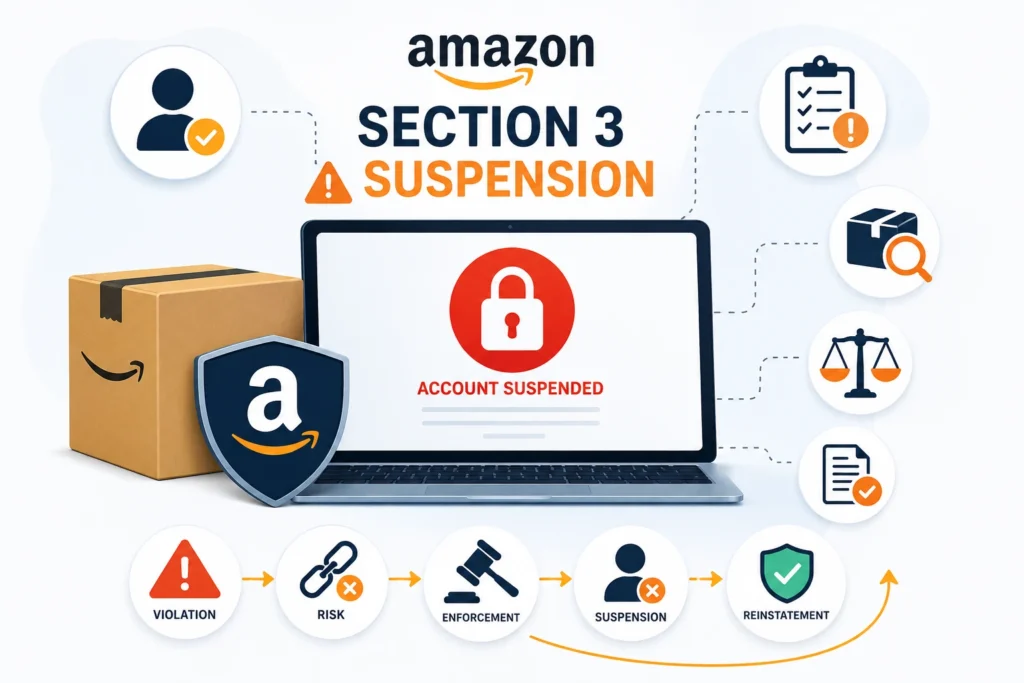
Section 3 of Amazon’s Business Solutions Agreement gives Amazon the authority to suspend or terminate selling privileges when it believes a seller has violated marketplace policies or created risks for customers.
Unlike performance-related issues such as late shipments or order defect rates, a Section 3 suspension is generally based on trust and compliance concerns.
Common reasons include:
- Identity verification issues
- Related or linked accounts
- Inauthentic product complaints
- Dropshipping policy violations
- Review manipulation
- Misleading business practices
- Code of Conduct violations
- Restricted product violations
When Amazon invokes Section 3, it is stating that it no longer has sufficient confidence in the seller’s account.
The Most Important Thing to Understand:
Amazon Section 3 is not the problem. It is the result of a problem Amazon believes already exists. Before submitting an appeal, you must identify the real reason Amazon took action.
Why Section 3 Suspensions Are So Serious
Potential consequences include:
- Immediate account deactivation
- Frozen disbursements
- Removal of selling privileges
- Inventory restrictions
- Loss of Buy Box eligibility
- Long-term damage to seller reputation
Account Termination
In severe cases, Amazon may permanently terminate the account.
New Sellers vs. Established Sellers
For new accounts, Section 3 suspensions are often related to identity verification issues.
- Mismatched names on documents
- Invalid utility bills
- Incorrect business information
- Incomplete verification records
For experienced sellers, suspensions are more commonly connected to policy violations or trust concerns.
- Inauthentic product complaints
- Linked accounts
- Review abuse
- Supply chain documentation problems
- Restricted product violations
The Most Common Causes of Amazon Section 3 Suspensions
1. Related Accounts
Amazon uses sophisticated systems to identify connections between seller accounts. Accounts may become linked through:
- Shared Wi-Fi networks
- Shared devices
- Shared bank accounts
- Shared business addresses
- Shared user access
If one linked account has enforcement issues, other connected accounts may also be suspended.
2. Inauthentic Product Complaints
One of the most common Section 3 triggers is an authenticity concern. This does not always mean a product is counterfeit. Amazon may suspend an account if sellers cannot provide:
- Valid commercial invoices
- Supplier verification
- Proof of product sourcing
- Brand authorization documentation
3. Identity Verification Problems
Amazon requires sellers to prove their identity and business legitimacy. Issues commonly arise when documents do not match Seller Central records, utility bills are outdated, business registrations contain inconsistencies, or verification documents appear altered.
4. Dropshipping Violations
Amazon allows dropshipping only when the seller remains the seller of record. Violations occur when orders are fulfilled directly from retail stores, third-party branding appears on packaging, or customer communication does not identify the seller.
5. Code of Conduct Violations
Amazon expects professional behavior from all sellers. Examples include review manipulation, incentivized reviews, competitor attacks, abusive communication, and policy circumvention.
What To Do Immediately After a Section 3 Suspension
If your account is suspended, avoid acting emotionally. Instead:
Review the Suspension Notice
Carefully read every detail of Amazon’s notification. Look for clues regarding related accounts, authenticity concerns, identity verification issues, or product compliance concerns.
Preserve Evidence
Download and save: Performance notifications, Account Health reports, Order history, Inventory reports, and Previous communications.
Identify the Root Cause
Do not assume the suspension reason. Investigate your account thoroughly before preparing an appeal.
Gather Supporting Documents
Collect all documentation relevant to the issue, including invoices, supplier agreements, utility bills, business licenses, compliance certificates, and authorization letters.
Why Most Appeals Fail
Many appeals are rejected because sellers fail to identify the real issue, submit generic templates, provide weak documentation, focus on emotions instead of facts, do not explain corrective actions, or ignore long-term prevention measures. Amazon wants evidence, not promises.
How to Write a Successful Plan of Action
A strong appeal typically contains three sections.
Root Cause
Explain exactly what caused the problem. Example: “Our inventory verification process failed to identify missing supplier documentation for affected products.”
Corrective Actions
Describe what has already been done. Example: “We removed the affected inventory and verified all supplier records.”
Preventive Measures
Explain how the issue will never happen again. Example: “We implemented a supplier verification checklist and quarterly compliance reviews.”
Evidence Required for Different Violations
- Commercial invoices
- Supplier contact information
- Proof of payment
- Brand authorization letters
- Government-issued ID
- Utility bill
- Business registration documents
- Bank statements
- Separate business documentation
- Different banking information
- Ownership verification
- Written explanation of any connection
- Supplier invoices
- Fulfillment workflows
- Warehouse agreements
- Shipping documentation
Can Amazon Section 3 Suspensions Be Reversed?
Many Section 3 suspensions are reinstated when sellers provide:
- Accurate root-cause analysis
- Strong supporting evidence
- Clear corrective actions
- Long-term prevention measures
How to Prevent a Future Section 3 Suspension
- Monitor account health
- Verify supplier documentation
- Maintain compliance records
- Audit product listings
- Review policy updates
- Train team members on Amazon requirements
- Maintain accurate business information
Final Thoughts
Amazon Section 3 suspensions are among the most serious enforcement actions a seller can face. They typically indicate that Amazon believes trust has been compromised.
The key to reinstatement is not rushing to submit an appeal. It is understanding the actual cause, gathering proper documentation, and presenting a clear, evidence-based Plan of Action.
Sellers who focus on compliance, documentation, and proactive account monitoring dramatically reduce their risk of future suspensions.
In Amazon’s marketplace, long-term success is built not only on sales growth but also on maintaining trust and compliance at every stage of the business.
Real Case Studies
Case 1: Documentation Gap
Reinstated in 3 Weeks
A seller sourcing branded health products from a regional distributor received authenticity complaints. The products were genuine, but invoices were formatted as sales receipts.
After a rejected first appeal, the seller obtained properly formatted commercial invoices and an authorization letter. The second appeal focused on the documentation gap and included a new invoice review step. The account was reinstated 19 days after the second appeal.
Case 2: Related Account
Reinstated After 2 Appeals
Frequently Asked Questions (FAQs)
An Amazon Section 3 violation occurs when Amazon believes a seller has breached the
Business Solutions Agreement or created a risk to customers, brands, or marketplace integrity.
Common causes include policy violations, identity verification issues, related accounts, and
authenticity concerns.
For new sellers, Section 3 suspensions are often caused by identity verification failures,
mismatched business information, invalid documentation, or incomplete onboarding
requirements.
Review times vary based on the complexity of the case. Simple verification issues may be
resolved within a few days, while investigations involving related accounts, authenticity
concerns, or supply chain documentation can take several weeks.
Amazon typically accepts government-issued identification, business registration documents,
utility bills, bank statements, and evidence proving operational separation between businesses.
The stronger the documentation, the higher the chances of a successful appeal.
No. While counterfeit complaints can trigger a Section 3 suspension, many cases are related to
identity verification, linked accounts, dropshipping violations, insufficient invoices, or code of
conduct concerns.
To appeal successfully:
1. Identify the actual reason for the suspension.
2. Gather all supporting documentation.
3. Write a clear Plan of Action (POA).
4. Explain the root cause.
5. Detail corrective actions taken.
6. Describe long-term preventive measures.
7. Submit the appeal through Seller Central.
Need Help With Your Amazon Section 3 Suspension?
Upsell Wholesale’s team has analyzed hundreds of Section 3 suspension notices. Contact us to analyze your suspension notice, audit documentation, and prepare an evidence-backed Plan of Action.
